
Something is not working on the British left, and we should be honest about that without turning it into a counsel of despair. Corbynism came closer to power than many expected and built genuine organisational capacity along the way. XR shifted public debate on climate in ways that had seemed impossible. The Palestine solidarity movement has demonstrated a scale of mobilisation not seen for decades. And yet none of these efforts has translated into durable collective power. Your Party launched with real energy and hope, but what has followed has been dispiriting: factional warfare, unclear strategy, and the slow draining of enthusiasm from people who had finally found something to commit to. Meanwhile Reform UK has gone from a marginal pressure group to topping the polls in the most recent local elections.
The diagnosis that we just need the right organisational form has been tested repeatedly and come up short. Social movement ecology offers a different starting point: not a new organisation, not a better strategy document, but a different way of seeing the field we are already organising within.
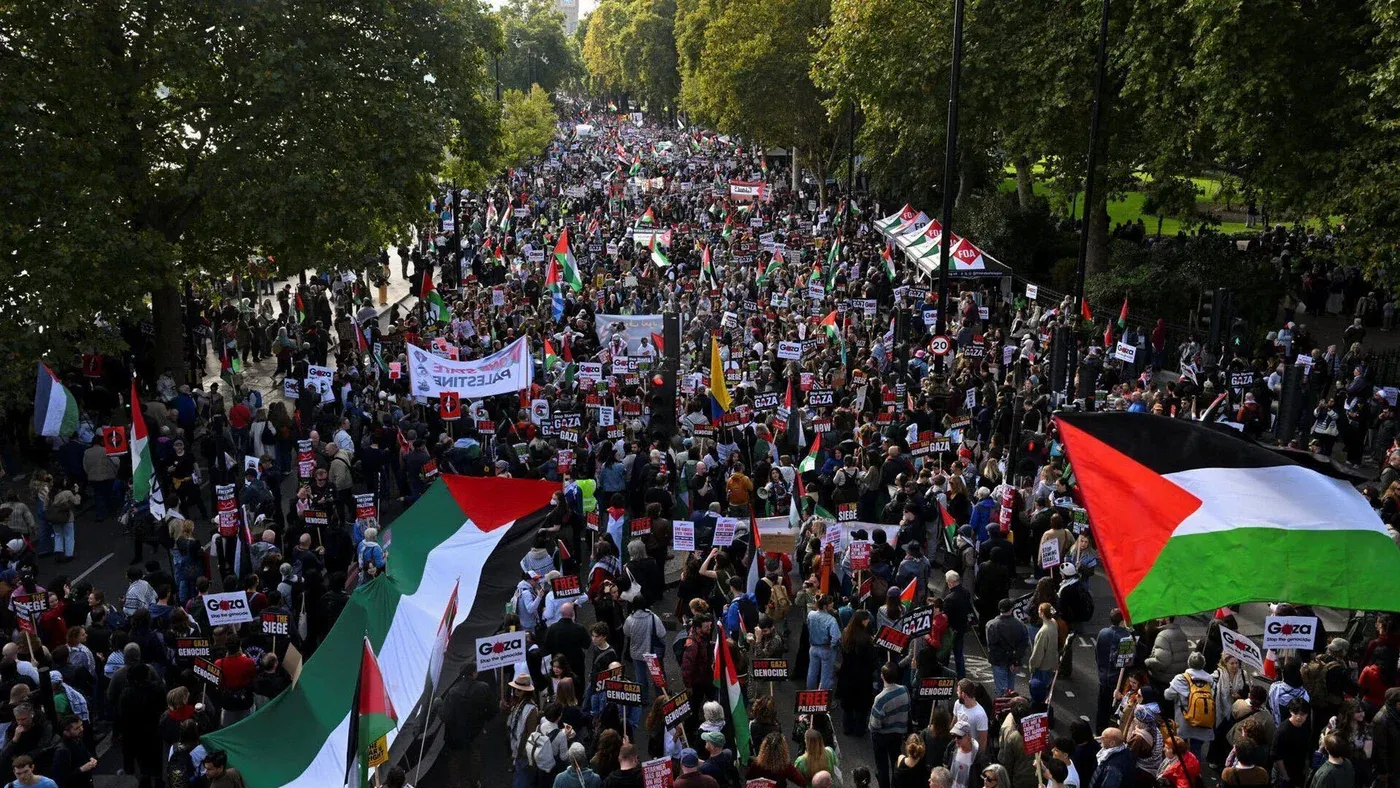
Movement ecology draws on complexity science and on Antonio Gramsci’s theory of hegemony: the idea that power in modern societies is wielded not by a single dominant group acting alone but through coalitions whose interests have been aligned, however partially and provisionally. Building collective power, in Gramscian terms, is the work of coalition-building across differences, forming sufficiently large alliances with each part influencing and being influenced by the others along the way. The ecology is the field in which that alliance-building happens.
When you zoom out far enough, this is what movement building actually looks like: You are not trying to build the one organisation that will deliver change; you are trying to strengthen a field of collective action whose output exceeds what any single actor could produce.
No one wins on their own
Systemic change is never the result of one organisation executing one strategy. Understanding how social movements create change means understanding that it always emerges from many actors, often uncoordinated, whose combined activity produces something none of them could have produced alone.
The campaign for same-sex marriage in the UK illustrates this. The legal victory in 2014 did not come from a single organisation. It came from decades of overlapping activity: legal challenges that shifted the terrain of rights, cultural shifts driven by changed representation in media, local community organising that rebuilt social norms from the ground up, parliamentary lobbying by specialist organisations, and a broader climate of public opinion slowly transformed by all of the above acting simultaneously. No one planned this as a coordinated whole. What produced the outcome was the accumulated effect of many different wagers placed over many years.
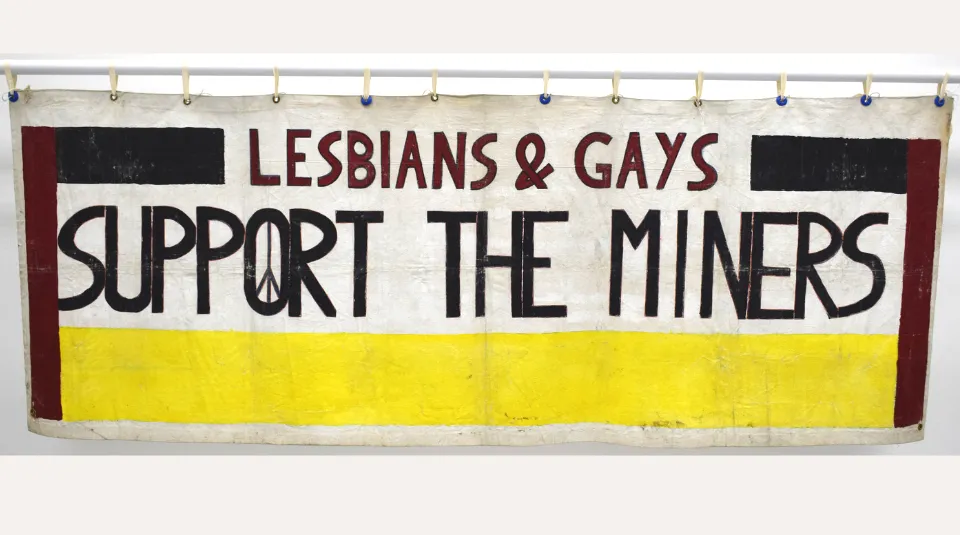
The same pattern shows up wherever you look at how movements win. The repeal of the prohibition against abortion services in Ireland (often credited to a Citizens’ Assembly, but actually the product of decades of grassroots organising, personal storytelling campaigns, diaspora networks and shifting cultural norms that made the Assembly possible in the first place). Lesbians and Gays Support the Miners during the 1984 strike (cross-movement solidarity that transformed both communities’ political horizons). The Indian independence movement (a vast ecology of non-cooperation campaigns, armed resistance, labour organising, cultural production and diplomatic pressure that operated across many organisations with fundamentally different strategies). The abolition of apartheid (internal resistance, international solidarity, cultural boycotts, armed struggle, sanctions campaigns, trade union action, diplomatic isolation, all pulling in roughly the same direction from radically different positions).
None of these was the execution of a plan. Each was the emergent result of a movement ecology. And in each case, what made the difference was not just a diversity of tactics (different ways of doing the same thing) but a diversity of strategies: fundamentally different theories of how change happens, pursued simultaneously by different actors, whose interaction produced outcomes none of them could have engineered alone. Complex problems require this. A single strategy, however well executed, addresses one dimension of a multi-dimensional system. It takes many strategies, pulling on different parts of the system at once, to move the whole.
How to think ecologically
Social movements are complex adaptive systems: networks of many interacting agents whose behaviour at the level of the whole emerges from those interactions rather than from any central design. Complex adaptive systems share specific properties: they are shaped by feedback loops (actions produce consequences that feed back into the conditions for further action); they exhibit non-linear dynamics (the relationship between effort and outcome is not proportional); and the system’s overall behaviour results from the interaction of its components (in other words, complex behaviour emerges from simple rules one level down).
This has strategic implications: there is no master plan that, if executed correctly, produces the desired outcome. Opponents, bystanders and allies will consistently surprise you. Being able to learn quickly from what is actually happening matters more than being right in advance. Large, well-resourced pushes in the wrong place can produce nothing. A conversation in the right room at the right time can shift a situation that seemed immovable.
When we have a well-connected ecology, we are far more likely to be able to meet the external conditions when they shift in our favour. When the field is fragmented, even brilliant individual work snaps back to the status quo. In a political moment defined by polarisation and the deliberate stoking of division, this fragmentation is not just inefficient. It is dangerous.
Start with what you have
One of the most important moves in ecological thinking is to shift which question we ask first. Instead of asking what the right organisational form is, we ask: what is the existing field of organisations we are already part of, and how do we strengthen it?
As Rodrigo Nunes writes:
If there is a normative dimension here, it does not lie in the imperative to create an ecology, as there always is one anyway, but in thinking about what exists in ecological terms. This entails, among other things, privileging cooperation over competition, nurturing common resources and mutually beneficial relations, and strategising with a broad field of other agents in mind.1Marginnote nunes-11Rodrigo Nunes (2021), Neither Vertical nor Horizontal: A Theory of Political Organization ↩
The British left in 2026 has parties new and old, revitalised unions and struggling ones, climate campaigns, Palestine solidarity, tenants’ organisations, mutual aid networks, independent electoral slates, local civic alliances, political education projects, and alternative media. Left organising in Britain is not short of activity. What is missing is not more organisations, campaigns or projects, but the connective tissue and strategic coherence to turn what exists into a force adequate to the moment.
Recognising this shifts the work from construction to cultivation. The connections built between mobilisations are what elevates the next mobilisation over the last. Shared objective conditions, however urgent, do not automatically generate collective agency. People and organisations can coexist for years without developing the mutual understanding that would allow them to act together. That connecting work is long-term, patient and compounding.
Different entities doing different jobs
Biological ecologies work because they contain different entities occupying different niches. Nunes calls this functional differentiation. A healthy movement ecology contains organisations doing genuinely different work: campaigning, community organising, political education, alternative media, legal support, mutual aid, electoral work, the unglamorous logistics of keeping things running between mobilisations.
No single organisation can or should try to do all of this. Each role looks insufficient on its own; it becomes meaningful alongside the others. The campaign that wins a victory needed the legal infrastructure that defended the arrestees, the political education that trained the organisers, the community organising that built the base. Pull out any layer and the next campaign is weaker.
Competition versus mutual support
Our society is structured around competition, and organisations get pulled into that logic in ways that damage the collective project. Organisations compete for funding, members, attention and legitimacy. The zero-sum logic of the market gets imported into the work of building collective power.
In reality, the wealth produced by any part of a movement ecology is a commons: collectively produced, available to everyone. An organiser trained by one organisation is a resource for every organisation they later work with. A successful campaign creates conditions for the next one. A widely circulated framing enters the common pool of political language.
Nunes is direct on what an ecological ethos requires:
The best one can hope for is that most participants of an ecology embody an ethos of acting ecologically, non-competitively, without a narcissistic investment in their own protagonism, placing the health and the interests of the ecology as a whole above their own or their organisation’s.2Marginnote nunes-22Ibid. ↩
The forces ranged against us are not playing zero-sum games among themselves. The right has built a coordinated ecology across think tanks, media outlets, party formations, donor networks and cultural projects, each occupying its niche, all broadly pulling in the same direction. We are losing in part because they have done what we have not.
Co-option and how to resist it
The current political-economic order does not just sit there waiting to be challenged. It actively absorbs, neutralises and co-opts alternatives. Campaigns win reforms that stabilise the system rather than weakening it. Cooperatives succeed on terms that do not challenge the market. Mutual aid networks provide care without politicisation. Each of these is an effort that the system’s self-correcting mechanisms have absorbed, returning conditions to something close to where they were before.
This is where movement ecology becomes essential rather than just useful. Isolated organisations acting alone are easy for the system to absorb: a single campaign can be co-opted, a single demand can be met with a token concession, a single alternative can be left to operate in a niche that does not threaten anything. But when many organisations are acting in the same direction, reading the field, learning from each other and adjusting their strategies in response to what is actually happening, the system’s capacity to absorb is overwhelmed. The damping mechanisms that neutralise isolated efforts cannot cope with distributed, coordinated pressure at multiple points simultaneously.
This is also why the ecology’s own internal dynamics matter so much. Fragmentation, competition between organisations, burnout, reactive decision-making driven by the accumulated wounds of past defeats: these are part of how the system maintains itself. They reproduce the current order inside the movements trying to change it. Building a healthier ecology is not a separate task from the work of systemic change. It is part of that work.
Two failure modes to avoid
There is a version of movement ecology that becomes a justification for avoiding hard questions about strategy: everyone does their thing, diversity is celebrated, and nobody asks whether the aggregate of all this activity is actually producing anything. Call this strategic relativism: the assumption that because all strategies come from genuine commitment, they cannot be assessed against each other. Every strategy is as good as the next one. This leaves the ecosystem unable to learn.
The second failure mode is the circular firing squad: endless debate between strategic approaches, each side trying to prove the others wrong, and worse, open attacks and active undermining. In a political moment defined by the deliberate stoking of division, the left doing the right’s work for it is not just wasteful. It is a gift to the people who want us fragmented.
Nunes names the alternative approach:
What matters is not finding a single strategy that works for the ecology as a whole but coming up with strategies that work within it. What emerges from that is not a single unified strategy run by a central command, but a sort of meta strategy playing out at the ecological scale, the overall direction of which is permanently at stake.3Marginnote nunes-33Ibid. ↩
The goal is to recognise the inherent diversity of a movement, resist the urge to force it into a single structure, and simultaneously develop the shared strategic awareness that allows that diversity to add up to something rather than dissipate into noise.
Collective positional intelligence
This is where it gets concrete. The difference between a collection of talented players and a good team is positional intelligence: each player knows where they are, where everyone else is, and what the situation calls for. Sometimes the right move is to take the shot. Sometimes it is to pass. Sometimes it is to hold position and not move at all.
In a movement ecology, each organisation needs to see the wider field, understand what others are doing, and project its own activity into the larger picture. Without this, diversity of strategies is just a polite name for everyone running their own race.
Nunes summarises the challenge
Ultimately, what an ecology needs is both sufficient concentration of strategic power on certain points (so that it will not become a cacophony) and that the capacity for strategic thinking be as widespread as possible (so that everyone can see and project their actions within a larger context).4Marginnote nunes-44Ibid. ↩
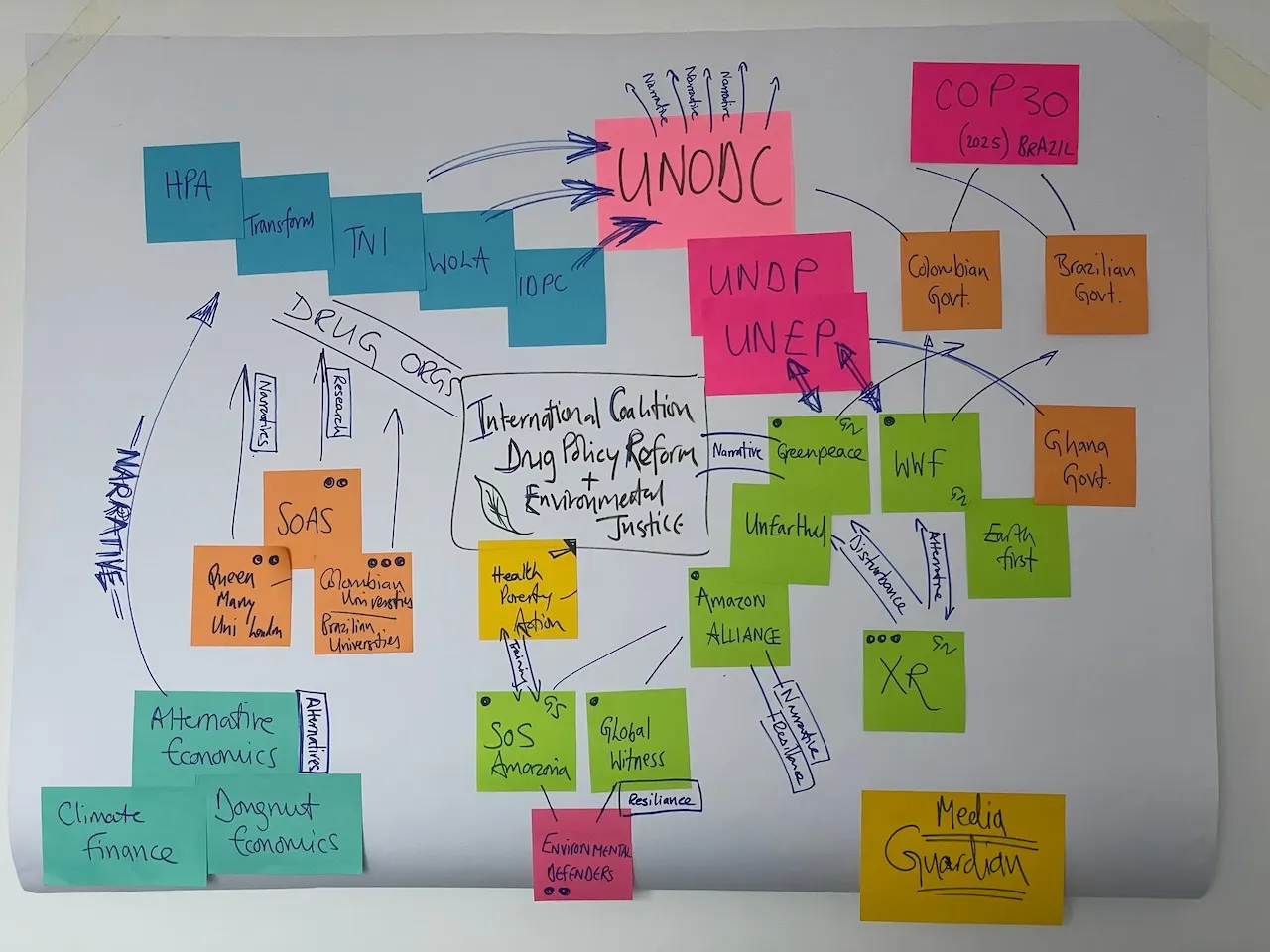
Building collective positional intelligence starts with mapping: making visible who is doing what, where the functional gaps are, and where the potential for collaboration lies. Organisations also work better when they understand each other beyond the surface: the theory of change behind another group’s tactics, the constraints they are working under, what they have tried before. This kind of mutual understanding makes genuine collaboration possible rather than polite coexistence. It is also what makes it possible to support each other to see blindspots, including the most uncomfortable kind: the ways we reproduce the dynamics we are trying to overcome.

What the moment requires
The aim is to develop the collective capacity to act with strategic coherence without requiring uniformity. Not a central command, not everyone agreeing on everything. But enough shared orientation, enough mutual understanding, enough practice of organising across difference, and enough honest assessment of what is and is not working to build the kind of collective power that can actually win.
The British left does not lack organisations, campaigns or energy. It lacks the connective tissue and strategic coherence to make those things add up to more than their parts. Building that connective tissue is not dopamine-rich work laden with visible achievement from the start. It is not the type of networking that makes everyone roll their eyes. It is the slow, deliberate work of building the relationships, the shared analysis, and the mutual trust between organisations that allows an ecology to act as something more than a collection of strangers who happen to care about the same things. It is what makes the difference between a field that fragments under pressure and one that holds – and act effectively in response.
The Movement Ecology Collective works with organisations that want to develop this thinking in practice: through ecosystem facilitation, Strategy Exchange sessions, political education and movement mapping. We are also running a short course with the School of System Change as part of their Seedling Series. The session explores why systems snap back, what separates a healthy ecology from a merely busy one, and how a diversity of strategies can add up to collective power rather than noise. Whether you work on a place-based project, inside a campaign or organisation, or support others to create change as a facilitator, consultant, or funder, you will leave with a sharper picture of the field you are organising within. Find out more and book your place.